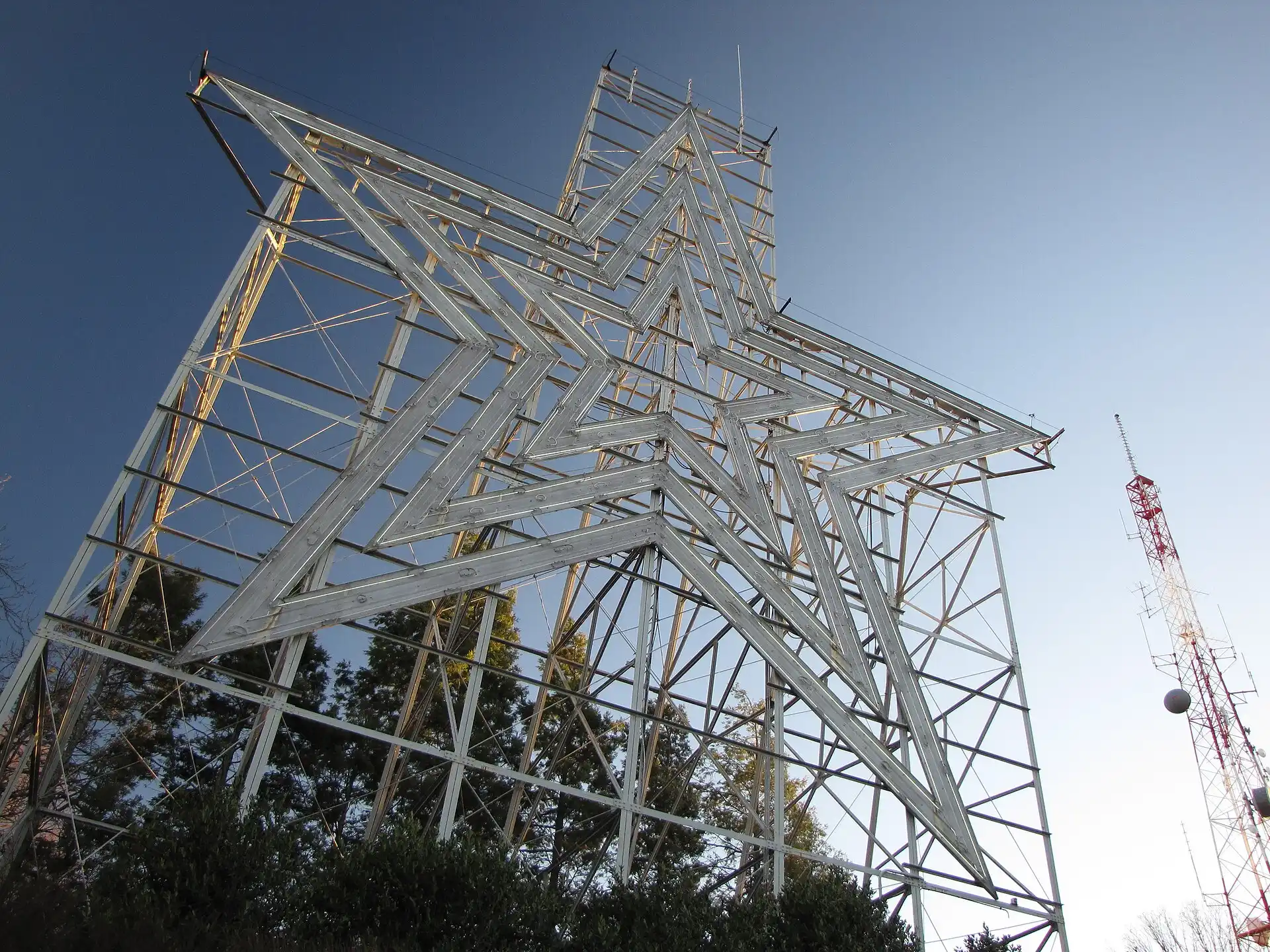
Roanoke grew from a railroad junction, was incorporated in 1882 and chartered as a city in 1884. It has 55 National Register listings, from the Roanoke Star to the 611.
Last checked Oct. 19, 2026. History comes from the City of Roanoke’s City Plan 2040 (PDF), the Virginia Department of Historic Resources’ register entries for Roanoke, Roanoke Parks and Recreation’s Roanoke Star page and the Historical Society of Western Virginia at roanokehistory.org. The list of historic places is the National Park Service’s National Register data (May 2026 file). Roanoke History Museum: 540-982-5465.
Roanoke is a railroad city. It grew where the Shenandoah Valley and Norfolk and Western railroads chose to meet, along a route that Native Americans had used as the Great Warrior Path and colonial settlers as the Great Wagon Road, according to the city’s comprehensive plan. The plan dates Roanoke’s incorporation to 1882, the year the Norfolk and Western arrived and set up its headquarters, and its charter as an independent city to 1884. By 1907 the city had about 30,000 people; today it covers just over 42 square miles.
Visit
- Roanoke History Museum and O. Winston Link Museum: 101 Shenandoah Ave. NE, 540-982-5465, 10 a.m. to 4:30 p.m. Tuesday to Saturday
- Virginia Museum of Transportation: 10 a.m. to 5 p.m. Tuesday to Saturday, 1 to 5 p.m. Sunday
- The Roanoke Star: Mill Mountain Park, 2000 J.B. Fishburn Parkway; parks are open 6 a.m. to 11 p.m.
The railroad years
The Norfolk and Western built its first Hotel Roanoke on the hill above downtown in 1882, the same year it moved its headquarters to Roanoke, according to the Virginia Department of Historic Resources (DHR). The present Tudor Revival hotel mostly dates from 1938. Across the tracks, the railroad’s 1896 and 1931 general office buildings and its 1905 passenger station, redesigned in 1949 by industrial designer Raymond Loewy, form the Norfolk and Western Railway Company Historic District. Below them, the warehouses of Wholesale Row on Norfolk Avenue went up between 1889 and 1902, when Roanoke was the wholesale capital of Southwest Virginia.
The city’s first market opened on Market Square in 1886; the current City Market Building replaced it in 1922. In 1907, a group of local women hired planner John Nolen to draw up a plan for the growing city, Roanoke’s first comprehensive plan, the city says. Many of its ideas, including parks and the parkways now called greenways, were carried out over time.
The Star City
The Roanoke Star on Mill Mountain was first lit at 8:22 p.m. on Nov. 23, 1949, by Mayor A.R. Minton. The Roanoke Merchants Association sponsored it as a Christmas decoration for the holiday shopping season, and it was supposed to come down in 1950. Built by Roy C. Kinsey of Kinsey Sign Co. and his two sons, it is three stars in one, 88.5 feet tall, with 2,000 feet of neon tubing. It shines white most of the year and red, white and blue on Memorial Day, Flag Day, Independence Day, Patriot Day and Veterans Day. It joined the National Register in 1999.
Museums and sites to visit
- Roanoke History Museum, O. Winston Link Museum and Raymond Loewy Gallery, in the old Norfolk and Western passenger station, renovated in 2001: 101 Shenandoah Ave. NE. Open 10 a.m. to 4:30 p.m. Tuesday through Saturday; closed Sunday and Monday.
- Virginia Museum of Transportation, home of Norfolk and Western Class J No. 611 and Class A No. 1218: open 10 a.m. to 5 p.m. Tuesday through Saturday and 1 to 5 p.m. Sunday. Its next big event is the Roanoke Railway Expo, Nov. 7-8.
- Crystal Spring Pump Station, beside Carilion Roanoke Memorial Hospital at the foot of Mill Mountain: the 1905 Snow steam pump that supplied downtown with water. Free, open noon to 4 p.m. Saturdays and 1 to 4 p.m. Sundays from May through September, and for groups by appointment.
- Mount Moriah Baptist Church and Cemetery, 3521 E. Orange Ave., on the National Register since 1994.
Historic districts
Roanoke has 17 National Register historic districts, among them the Roanoke City Market, Roanoke Downtown, Southwest (Old Southwest), Gainsboro, Grandin Road Commercial, Wasena, Belmont, Norwich and Melrose-Rugby districts. The city protects downtown (its H-1 district) and Gainsboro and Old Southwest (H-2) with local design review; see our building permits and zoning guide.
Every National Register listing in the city
| Listed | Property |
|---|---|
| 1973 | Fire Station No. 1, 13 E. Church Ave.; St. Andrew’s Roman Catholic Church, 631 N. Jefferson St. |
| 1974 | Buena Vista; Monterey |
| 1980 | Crystal Spring Steam Pumping Station; Mountain View, 714 13th St. SW |
| 1982 | First National Bank, 101 S. Jefferson St.; Harrison School, 523 Harrison Ave. NW |
| 1983 | Roanoke Warehouse Historic District; Roanoke City Market Historic District (enlarged 2002); Colonial National Bank |
| 1984 | Boxley Building, 416 Jefferson St. SW |
| 1985 | Southwest Historic District (enlarged 2020) |
| 1991 | Campbell Avenue Complex; Roanoke City Firehouse No. 6; Patrick Henry Hotel; St. John’s Episcopal Church; Huntingdon |
| 1994 | Mount Moriah Baptist Church and Cemetery |
| 1996 | Hotel Roanoke; The Coffee Pot, 2902 Brambleton Ave. SW; Gainsboro Branch of the Roanoke City Public Library |
| 1999 | Norfolk and Western Railway Company Historic District; Roanoke Star |
| 2002 | Roanoke Downtown Historic District (enlarged 2007 and 2013); Grandin Road Commercial Historic District |
| 2003 | Virginian Railway Passenger Station; Burrell Memorial Hospital |
| 2004 | Boxley-Sprinkle House; Henry Street Historic District |
| 2005 | Gainsboro Historic District |
| 2006 | Roanoke Apartments |
| 2007 | Salem Avenue-Roanoke Automotive Commercial Historic District (enlarged 2008 and 2014) |
| 2008 | H.L. Lawson and Son Warehouse |
| 2010 | Apartment Building on Windsor Avenue and Brunswick Street |
| 2011 | Belmont Methodist-Episcopal Church; City of Roanoke Fire Station No. 5 |
| 2012 | Wasena Historic District; Carlin’s Amoco Station; Norfolk and Western Railway Freight Station; Tayloe Rogers House |
| 2013 | Melrose-Rugby Historic District; Riverland Historic District; Roanoke River and Railroad Historic District |
| 2016 | Roanoke City Health Center |
| 2018 | Villa Heights |
| 2019 | Belmont Historic District; American Viscose Plant Historic District |
| 2020 | Salvation Army Citadel |
| 2022 | English Gardens |
| 2023 | Colony House Motor Lodge |
| 2024 | Norfolk and Western Class J No. 611 Locomotive; Norwich Historic District |
| 2025 | Norfolk and Western Class A No. 1218 Locomotive; Lucy Addison High School |
The Park Service file also places the Harshbarger House under the city, but its address is in Roanoke County, so it is not counted here. Many listed houses are private homes; view them from the street.
Related guides: parks and trails in Roanoke, Roanoke population and growth and things to do in Roanoke this month.
Frequently asked questions
When was Roanoke, Virginia, founded?
Roanoke grew up where the Shenandoah Valley and Norfolk and Western railroads chose to meet. The city’s comprehensive plan dates its incorporation to 1882 and its charter as an independent city to 1884.
Why is Roanoke called the Star City?
For the Roanoke Star on Mill Mountain, first lit on Nov. 23, 1949. It was meant to be a temporary Christmas decoration for the holiday shopping season and was never taken down.
How many National Register historic places are in Roanoke?
The National Park Service lists 55 properties and districts in the city of Roanoke on the National Register of Historic Places, from Fire Station No. 1 in 1973 to Lucy Addison High School in 2025.
Where is the Roanoke History Museum?
In the former Norfolk and Western passenger station at 101 Shenandoah Ave. NE, shared with the O. Winston Link Museum. It is open 10 a.m. to 4:30 p.m. Tuesday through Saturday.
Is the 611 steam locomotive on the National Register?
Yes. Norfolk and Western Class J No. 611 was listed in 2024 and Class A No. 1218 in 2025. Both are at 303 Norfolk Ave. SW, home of the Virginia Museum of Transportation.
Have your say