Roanoke's Hope and Home Task Force wants a 24/7 regional help hub, a pilot village of 10 to 14 small homes and a housing study. Its report is now public.
Overview
Roanoke’s Hope and Home Task Force has sent City Council its final plan on homelessness. Its main asks are a round-the-clock regional help hub, a pilot village of 10 to 14 small homes, a new citywide housing study and full enforcement of camping laws. None of it is approved or funded yet.
The 67-page report is dated Oct. 27. It is posted on the city’s Hope and Home Task Force page, along with the slides shown to the council.
Mayor Joseph L. Cobb formed the task force, and the council endorsed it in August 2025. Its 21 volunteer members live or work in the city. They include people from health care, housing, schools, churches, business, neighborhood groups and people who have been homeless. Virginia Tech’s Center for Economic and Community Engagement supported the work.
The numbers behind the plan
The report draws on local counts and housing data:
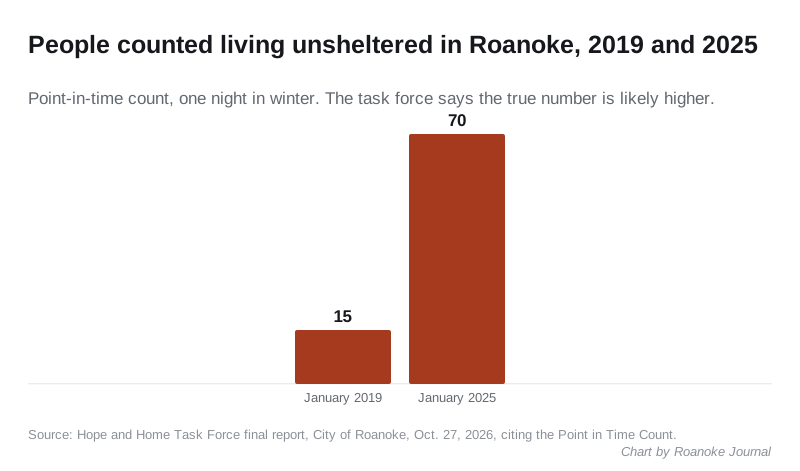
- Unsheltered homelessness: the winter point-in-time count found 15 people living unsheltered in Roanoke in 2019 and 70 in 2025. The report says the real number is likely much higher, because the count is taken in winter.
- Regionwide: the January 2025 count found 389 people homeless across the Roanoke region. The most common reason given was losing a job, followed by being unable to find affordable housing.
- Rent: the fair market rent for a one-bedroom apartment in Roanoke rose from $646 in 2019 to $1,053 in 2026, a 63% increase.
- Cost burden: 35% of households in the city spend at least 30% of their income on housing.
- Where people come from: the available data suggests more than 60% of unhoused people lived in Roanoke before they lost their housing, the report says.
The four main recommendations
The task force split into four work groups. Each made one main recommendation and several smaller ones.
| Work group | Main recommendation |
|---|---|
| Housing and economic security | A new housing analysis and property inventory, then a citywide strategy to add housing |
| Shelter, services and safety | A regional access hub, and more staff for the city’s Homeless Assistance Team |
| Health and human services | Better coordination of community health workers |
| Business, quality of life and economy | Fully enforce camping laws, extend the downtown camping ordinance citywide and review how the rules are enforced |
A 24/7 hub
The hub would be a “no wrong door” system for people in crisis, the report says. It would include:
- a 24/7 warm line and an online app
- crisis help from community health workers
- transportation
- one shared intake process across agencies
It would start with existing and grant-funded staff. The report says one more health worker or peer recovery post, at about $60,000 to $75,000 a year, may be needed after 18 to 24 months.
A small house village
The pilot would build 10 to 14 small homes as transitional housing, with case management and behavioral health support on site. The report estimates $40,000 to $50,000 a home, or $750,000 to $1 million in all, plus land and site work. On-site services would need about one full-time worker at $80,000 a year. It suggests looking for land the city already owns.
Camping rules
The report says residents and businesses have raised concerns about camping, and some asked for tighter ordinances. It recommends first reviewing what the city’s ordinances allow and how they are enforced. It says stronger enforcement must go hand in hand with more access to services and shelter.
The other recommendations
They include:
- an affordable housing incentives package and a faster building permit process
- a larger city land bank
- a 6- to 10-bed medical respite program
- safe, coordinated discharge protocols, so people are not discharged without support
- a transit pass for people traveling between services
- a resource toolkit for businesses and residents
What happens next
The council has not voted on any of the recommendations. The report asks the city to name an implementation committee to work with city staff and service providers. It also calls for “a more visible and concerted public input process” to refine the plan.
The report marks the housing study and the health worker coordination as short-term, a year or less. The hub, the small house village and the camping review are marked mid-term, one to three years.
What it means for you
- Read the plan yourself. The full report and the council slides are on the task force page.
- Have your say. The task force takes email at hopeandhome@roanokeva.gov. The report says more public input is still to come.
- If you or someone you know needs housing help now, the report lists the Council of Community Services’ 211 line among the region’s resources. Dial 211.
Have your say